Published on:
17 July 2026
Share this:
Oct. 18 th , 2023:
- Scotland: red alert for up to 10 inches of rain, severe flooding, and life-threatening conditions.
- Ghana: 26,000 flee their homes after unprecedented rainfall requires two massive dams to release water or risk collapse.
- Barbados and Martinique: residents brace for Tropical Storm Tammy’s pounding rains and 65 mph winds.
One day. Three flooding disasters.
This is not normal…
Unfortunately, it’s happening far too often. Globally, flooding is the most common disaster risk affecting all segments of society, regardless of income, location, age or ethnicity. And thanks to climate change impacts, habitat destruction and growing cities, disastrous floods are on the rise…everywhere.
We are not powerless, though, and we do not have to accept the growing risk. Working with nature as a key line of defense, we have the tools and know-how to anticipate, prepare for and manage the impacts. We won’t stop floods, but we can save lives and property by outmaneuvering the worst effects. Over the past 10 years, World Wildlife Fund’s (WWF) Environment and Disaster Management (EDM) Program has helped change the narrative on flood risk management.
In partnership with the U.S. Agency for International Development (USAID), the EDM Program literally wrote the book on how to incorporate green, natural and nature-based practices into flood disaster preparation and recovery. The EDM Program has trained hundreds of engineers, policy makers, students, professors, community organizers, humanitarian and development actors from over 30 countries, supported policy changes on nature-based solutions, and written guidelines and manuals for other organizations that have educated and influenced thousands.
“Storms, fires, floods, drought and extreme temperatures are becoming more frequent and more ferocious, and they’re on course to get far worse. Lives and livelihoods are being lost and destroyed, with the vulnerable suffering the most. Yet as needs rise, action is stalling.”
António Guterres, United Nations Secretary-General
Keeping up with the times
In some places, floods are a natural part of healthy, functioning ecosystems. They deposit nutrients that support agriculture, transport sediment, filter water and support fisheries. But when climate change, habitat degradation and growing urban development interfere with that natural cycle, disaster risk can and does increase. Destructive floods cause immense devastation to ecosystems, communities, and economies around the world.
Historically, flood control was managed through hard or gray engineering solutions such as dams, levees and culverts, often leading to unintended consequences such as disruption of river ecosystems, inundation of culturally and economically important land, and a loss of valuable nutrients that are carried in sediment. They may even introduce flood risk into new areas previously unaffected by floods.
The good news is that a growing movement is working to change this, by putting nature at the center of the equation and using greener techniques such as better land use planning, wetlands and riverbed restoration, and soil conservation. “Nature is important because it’s part of our global safety net,” says Anita van Breda, senior director, Environment and Disaster Management at World Wildlife Fund (WWF). “There are limits to the capacity of structural engineering, so nature is a logical partner in managing flood risk.”
“Where I’m coming from, flood control is quite the opposite of nature-based, and often only uses hard structural methods such as dams. I’ve found that engineers generally have a narrow approach to flood-related problems. We think about a small stretch of river but do not traditionally look at the broader context of the watershed.”
Pakistani Flood Green Guide trainee Hasan Arshad Nasir, 2019
Writing the book on nature-based flood management
Van Breda started WWF’s Environment and Disaster Management program from scratch, in the wake of the devastating 2004 Indian Ocean tsunami. She partnered with the American Red Cross to maximize benefits for affected communities in Indonesia, Maldives, Sri Lanka and Thailand by minimizing or eliminating the negative environmental impacts of rebuilding efforts. Van Breda then turned her attention to flood disaster risk and was the driving force behind the creation of Natural and Nature-Based Flood Management: A Green Guide, developed in partnership with the U.S. Agency for International Development (USAID). More commonly called the Flood Green Guide (FGG), it is a framework to help flood managers, communities, companies and city leaders around the world include nature-based methods in flood management plans. The book is available in print in several languages and as an E-book that includes easy navigation and quick downloads of higher resolution diagrams and tables.
“By making nature a core part of our disaster recovery strategies — leveraging all the benefits that forests and other ecosystems provide — we can rebuild communities stronger and more resilient than before.”
Anita van Breda, WWF Senior Director of Environment and Disaster Management
Van Breda says that USAID’s support for the Flood Green Guide was based on a recognition that funding hard engineering solutions such as dikes, levees and seawalls for the increasing number of floods around the world was of limited utility. “They get tired of funding the same floods over and over again,” van Breda says. “So to their credit, they saw that we have to do something different. Hard engineering alone was not going to be sufficient or safe, anymore and we need to offer people an alternative.”
Turning words into action
The Flood Green Guide is only as good as the people who will study it, learn from it, and ultimately make things happen on the ground. From Bangladesh to Uganda, Sri Lanka, Guatemala and the United States, hundreds of people from all backgrounds and levels of expertise have attended Flood Green Guide training sessions either virtually or in person.
The Flood Green Guide Training Curriculum covers a range of key topics, including flood risk analysis, climate assessments, objective setting, method selection, community engagement, and urban issues. The training methodology and continuing education series include a combination of lectures, presentations, individual and participatory group exercises, scenario planning, communication products, and knowledge exchange.
Participants from 30 countries participated in these trainings across Africa, Latin America and the Caribbean and South-East Asia including Paraguay, Liberia, Philippines, Nepal, The Bahamas, Colombia, Rwanda, Cambodia, Uganda, India, Sri Lanka, Peru, Mexico, Guatemala, Pakistan, Bangladesh, Myanmar, Madagascar, Kenya, Zimbabwe, Namibia, Zambia, Cameroon, Malaysia, Bhutan, Indonesia, Thailand, Indonesia, Vietnam, Laos.
Countries where Flood Green Guide trainings have taken place
In addition to geographical diversity, the trainings also included participants from a variety of backgrounds, including: water managers, environmental scientists, humanitarian professionals, community members, community organization staff, community organizers, and municipal representatives. “There are a lot of manuals, guidebooks and reports but that only goes so far,” van Breda says. “There’s just no substitute for working with people in person to actually apply these strategies and approaches.”
Van Breda is currently fielding multiple requests for more training, searching for partners, funders and collaborators to work with and ensuring the manual and training materials are kept up to date and available to all. “If you can’t constantly improve and update it, any manual is going to be quickly dated, so we are working to understand how people are experiencing and using the materials and training, and then we improve them.
“And that takes time. That takes people – the so-called boots on the ground.”
Tools of the trade
To help flood managers go beyond the FGG, several additional tools have been developed by the Environment and Disaster Management team. The FGG Knowledge Map is a web-based tool that allows FGG users to easily explore and navigate various subject matters related to Nature-based Methods for Flood Risk Management.
EdApp is a Learning Management System to enhance training and development capabilities. This system allows increased interactivity and engagement with FGG training materials and facilitates the acquisition and analysis of data about the participants interaction with the training content.
Training the Next Generation
Youth represent half the world’s population. They are just as vulnerable to catastrophic flooding but they are usually left out of decision making and planning. That needs to change, since today’s youth are tomorrow’s flood managers.
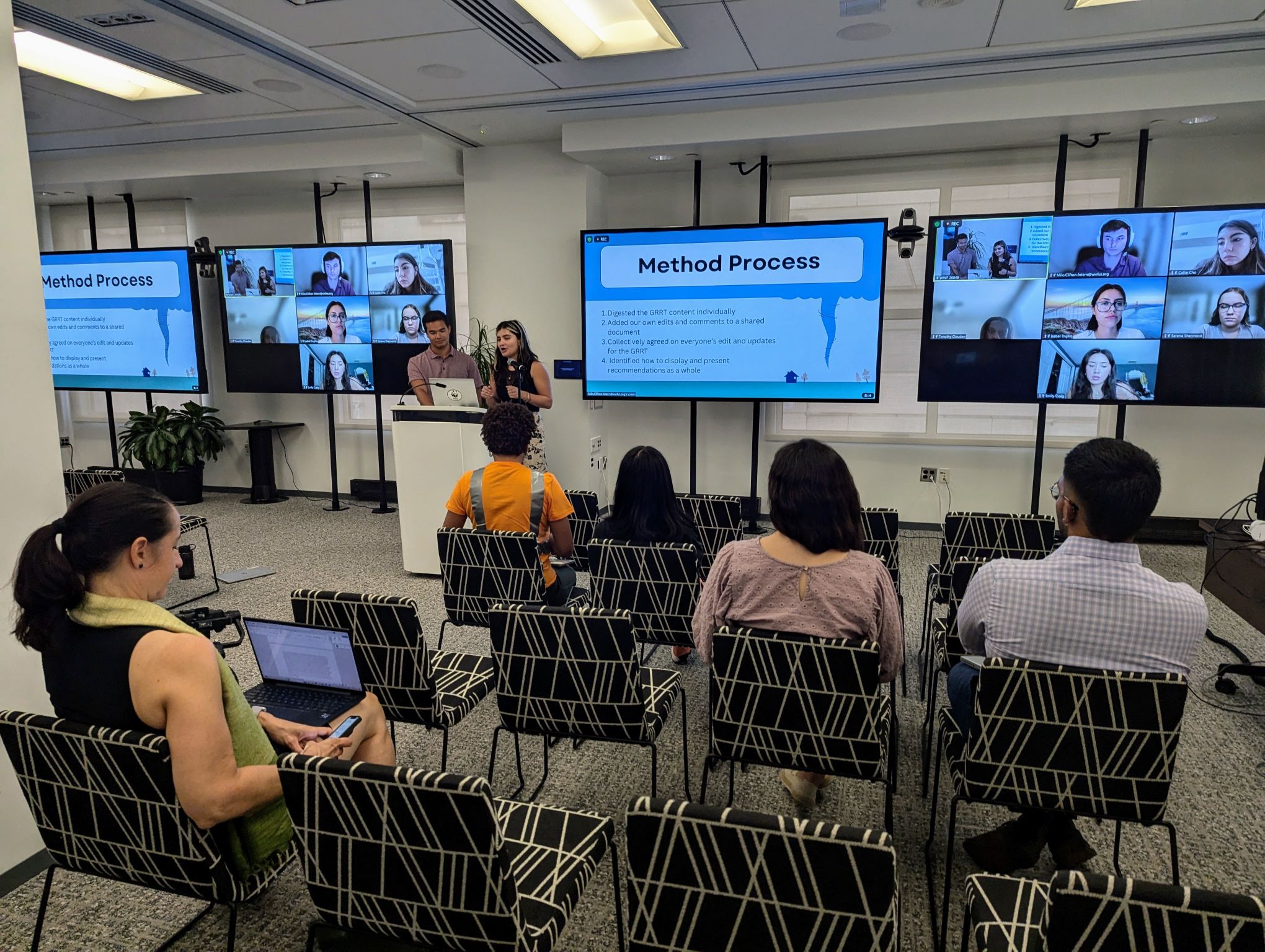
It’s the main reason WWF began the Flood Green Guide Youth Champions Program in 2023 with a simple goal — inspiring the next generation of leaders to become change agents in their communities and advocates for nature-based approaches to flood management. Nine young leaders from Africa, Asia-Pacific and Latin America and the Caribbean were chosen from over 400 applicants ranging in age from 24-30 for a pilot program developed by WWF. During a week full of strategy and training sessions, role playing games, and instruction from leaders in flood management, they gained a foundational understanding of nature-based flood risk management, disaster risk and climate change adaptation concepts. But the main output of the pilot program was to co-create a youth engagement program that meaningfully incorporates the knowledge and ideas of youth at the forefront of the climate crisis.
After learning about the Flood Green Guide, workshop participants shared their own experiences in youth engagement – what has worked and what hasn’t. They learned from each other’s experiences and compared them with their own countries. Shreya K.C., a climate justice activist who has been featured in two books, including “50 Girls Who Are Saving Our Planet,” described growing up in Nepal and experiencing firsthand the impacts of flood and landslides.
“It had a profound impact on me, and I’ve been compelled to understand its cause since I was a child,” Shreya wrote in a blog following the workshop. She also highlights the importance of intergenerational and intercultural collaboration by quoting The African proverb, “Youths can walk fast but elders know the way.” This “rings true in the case of flood risk management,” she adds. “Youth can be harnessed as bridges between generations and segments of society.
Flood Green Guide : 2023 Youth Champions Pilot Program
FGG by the numbers
21: FGG trainings conducted 470: people trained on FGG background and methods 30: Countries with FGG training participants in Africa, Latin America and the Caribbean and South-East Asia 15 speaking events and/or one-off events where the FGG was promoted, reaching more than 2220 people around the world. 2: training of trainers (ToT) sessions in Asia and Latin America, with over half of participants women and plans to offer more opportunities 4: Youth-focused trainings and engagements conducted, including 2 in person in Sri Lanka and 2 virtual programs 11: EDM Continuing Education seminar programs on nature-based flood management 13: Policy/institutional changes resulting from FGG recommendations
Far-reaching impact
- The Flood Green Guide recommendations have led to at least 13 policy/institutional changes, ranging from the creation of a new public sector unit to better integrate nature-based solutions in Sri Lanka to the strengthening of financing mechanisms for natural and nature-based flood management in Pakistan.
- In Malaysia, the Government strengthened the Strategic Plan 2021- 2025 by including the theme “Building with Nature and creating for Resilience.”
- EDM staff served on the writing team for the US Army Corps of Engineers guidelines for reducing flood risk and improving the resilience of coastal and inland water systems.
- Key principles of the Flood Green Guide helped inform new United Nations guidelines on disaster management and transboundary cooperation.
- WWF’s Dr. Missaka Hettiarachchi was the lead author of “Wetlands and Disaster Risk Reduction: A Guide for Wetlands Managers” published by UNEP in December 2022 and featuring FGG key principles and approaches.
- National Institute of Disaster Management (NIDM) India incorporated FGG into their annual 2022-2023 training and plans to replicate FGG trainings in the future.
- Natural and nature-based methods for flood management are included in local action plans for Caribbean and Pacific priority areas in Colombia through the project Mangroves for Communities and Climate, funded by the Bezos Earth Fund.
- The UN Environment Program’s City Adapt program encompasses a series of climate change adaptation projects in cities in Latin America and the Caribbean. Following an FGG training, the City Adapt team is exploring options for potential replication in other cities in Mexico and beyond for the program’s second phase.
- A diversity of backgrounds are included amongst FGG trainees, includes water managers, environmental scientists, humanitarian professionals, community members, and municipal representatives.
Demonstrating impact on the ground
..in Guatemala
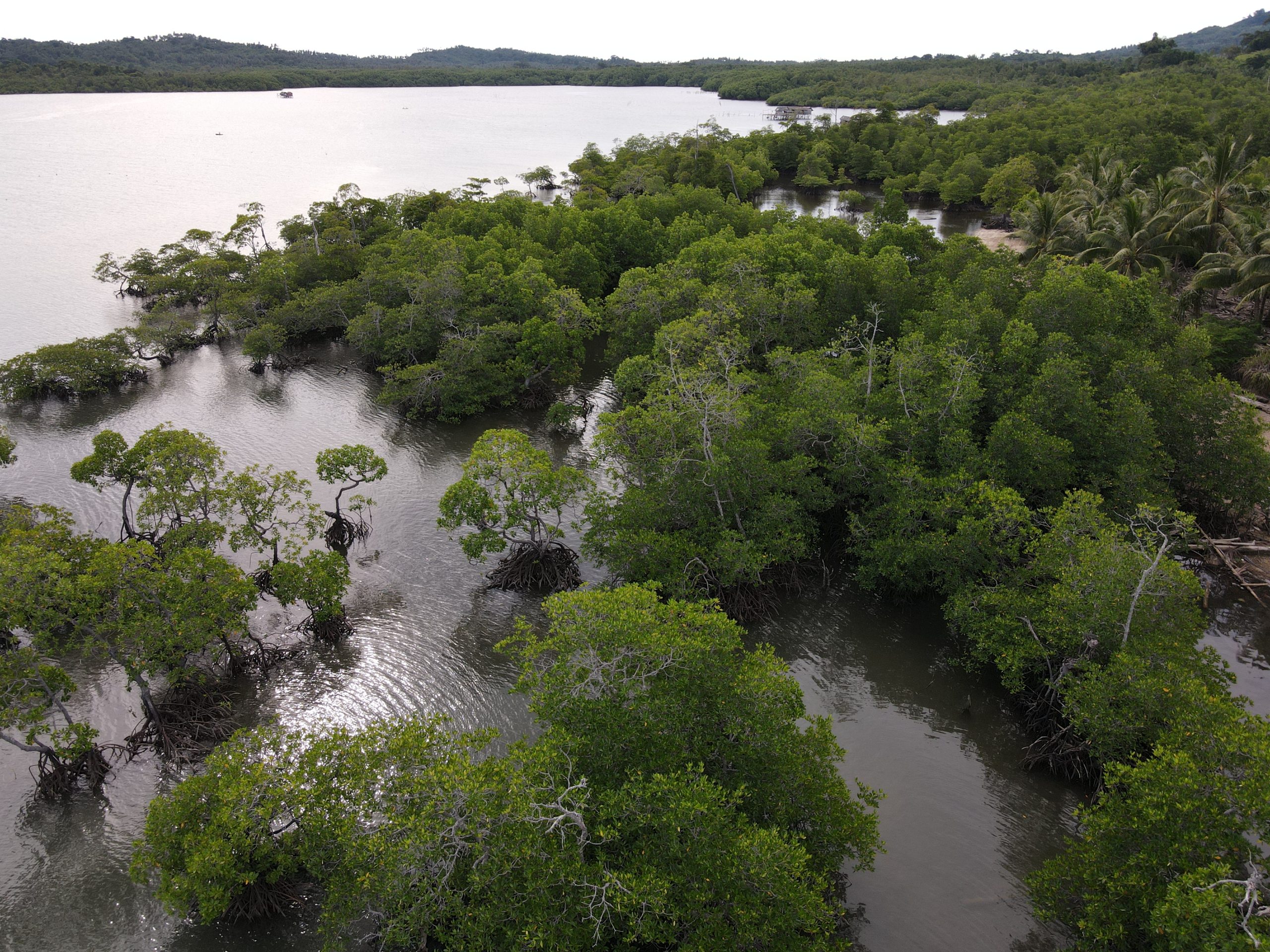
Government official Carlos Telón took the lessons he learned from a Flood Green Guide training in 2021 and helped plant 30,000 red mangrove seedlings, restore an area of 10 acres, and promote the conservation of over 1600 acres of mangroves for climate adaptation in coastal southern Guatemala.
Telón has also worked to reduce solid waste in this area by collaborating with the company INGRUP to collect tons of plastic waste. Construction is also underway for two waste sorting plants in the cities of Iztapa and Escuintla, again with support from WWF, which will be crucial for improved waste management in the region. Plastic waste increases flood risk by blocking drainage systems.
About 40 percent of Telón’s municipality is susceptible to flooding, Telón says, and with increasingly unpredictable weather patterns, flood events could be on the rise. However, he feels better prepared than in previous seasons, thanks to the municipality’s Climate Action Plan, and the tools and lessons from the Flood Green Guide training.
Telón feels a responsibility to pass on his knowledge from the Flood Green Guide training, especially since government officers often change after elections. Only one of the representatives who took the 2021 training with him are still working for the municipality.
“Part of what I’m doing is transferring that knowledge from the training to the new people who come in,” he says. “And they are implementing parts of the action plan that came from the Flood Green Guide. It would be useful for other municipalities taking the training to have a climate action plan in progress, so they can take what they learn and apply it directly.
“The training was even more helpful because we already had the Climate Action Plan, so we were able to use the Flood Green Guide within that framework,” Telón adds. The municipality’s greenhouse gas inventory, Climate Action Plan and Flood Green Guide training are guiding the design of adaptation and mitigation measures.
..in Pakistan
Another person who has embraced the Flood Green Guide as an essential part of his work is Abdul Waheed with Pakistan’s National Disaster Risk Management Fund. As one of the top 10 most climate vulnerable countries in the world, Pakistan regularly suffers devastating floods costing thousands of lives, millions of destroyed houses and billions of dollars in economic losses.
He says recent massive, deadly floods in 2010 and 2022 have increased awareness and adoption of more proactive flood management, however the system is still mostly “response-oriented.” The lesson he learned from the Flood Green Guide training is that developing country-wide flood management strategies requires a comprehensive risk assessment process that includes all stakeholder and technical experts.
“Watershed-level hybrid approaches are the only sustainable way for tackling floods and climate change,” he says. “I am using these learnings {from the FGG} in my work, while appraising projects and building capacities of the partners (government/ non-government organizations and Community Organizations).
He feels there is a sea change in the flood management community about how its leaders approach their work. “Now there is greater realization in different quarters and high-ups of the government and relevant institutes about the Flood Green Guide, and they are trying to incorporate it into their working environment,” Waheed says. “This is making a difference, and authorities are more emphasizing river laws and policies for flood management now, and introducing these approaches at the community level.”
..in Rwanda
“The knowledge and experiences gained from the FGG program have been instrumental in my work, particularly in designing new projects where I have been able to advocate for natural and nature-based flood management,” says Jeannette Iranzi, who participated in the pilot program of the Flood Green Guide Youth Champions. “One example is when my team and I were drafting a project proposal. Initially, they were relying on conventional methods, but I encouraged them to incorporate flood vulnerability assessments and Nature-based Solutions to complement the existing hard infrastructure solutions in the project site.”
Iranzi is an emerging environmental leader who has experience in youth engagement, climate justice and monitoring and evaluation. She served as the Monitoring Evaluation Accountability and Learning (MEAL) Officer for Nature Rwanda – a local non-governmental youth-led conservation organization and has been involved in programs from the U.S. Department of State, Texas Southern University, the U.N. Pact for the Future 2024 and WWF’s Global Youth for the Future initiative.
Of the Flood Green Guide Youth Champions Program, Iranzi notes that “it’s opening our eyes on how we can harness the power of young people in securing our future. I’ve been displaced by flooding in my community with other people, and so by contributing to this kind of program, I feel like I’m coming from vulnerability to resilience.”
..in the United States
Anita van Breda and Missaka Hettiarachchi were co-authors of the US Army Corps of Engineers’ International Guidelines on Natural and Nature-Based Features (NNBF) for Flood Risk Management. Launched at a virtual international event in 2021, the guidelines inform strategies to reduce flood risk and improve the resilience of coastal and inland water systems. WWF was part of the guideline development team, sharing the approach and experience from the Flood Green Guide. Anita van Breda, WWF Senior Director, provided the keynote address at the Guideline launch event.
Telling the Flood Green Guide story
A crucial part of the FGG involves raising awareness on the role of nature-based flood management methods via online stories, videos, podcasts and social media. The FGG has been promoted at more than 15 speaking events, reaching more than 2220 people around the world. Dozens of case studies or stories related to the Flood Green Guide are available on the website. Over 12 of those stories relate specifically to the FGG trainings, including three which were translated into Spanish.
Examples of storytelling include:
- an article and a continuing education seminar series on a successful early warning system for coastal communities in Madagascar.
- a 4-part flood-themed podcast with America Adapts about how people around the world, from the Netherlands to China to California, are working with nature to manage flood risk.
- an opinion piece entitled: ‘Why there is no such thing as a natural disaster’ for CNN’s series: Is America Ready for Disaster
- an article and a podcast about the Flood Green Guide Youth Champions Program.
- a case study about how North Carolina is adopting Nature-based Solutions to flooding.
- an animated video (below) that clearly and concisely tells the story of nature-based flood management for a variety of audiences.
- a video feature about a Kolkata-based researcher and conservation activist explaining how the concepts she learned at a Flood Green Guide training helped her understand the critical role of ecosystems in urban flood risk management.
- a feature article that tells a powerful personal story to highlight a hugely successful model that is being replicated around the world. WWF Madagascar and Aquatic Services, a local NGO, designed and deployed an early warning system for severe wind events that has strengthened fishing communities’ resilience and saved lives. This work was presented as part of the Flood Green Guide Continuing Education Seminar series. It is available in both French and English.
Nowhere is immune
Van Breda says that storytelling is so important because flood disasters are now impacting people everywhere, including the Washington, D.C. area where she lives. “I do think everybody is going to face it at some level, and they’re going to be impacted,” she says. “These crises are not going to stay localized, and we’re not prepared for that.”
She describes a recent night in Washington, DC with gale force winds and drenching rains that caused flooding on newly built roads unable to handle such a deluge. “Our infrastructure in this country, and a lot of countries around the world, it was built for a stationary climate,” she says. So I don’t see too many communities going unscathed, either by direct impacts or the indirect impacts.”
This will cause competition for water and other essential needs, displacement of communities, and necessitate planners and responders building relationships across sectors.
“That’s where I think we need collective action in both the environmental sector and the disaster management sector. We need a commitment to collective creative thinking and scenario planning and relationship building to reduce disaster risk, and when an extreme event happens, we’re a little bit better prepared to navigate it and manage it.”